Tuesday, 15 November 2011

Style & Substance


Wandering around the wine merchants of London, I have recently noticed a trend in the way these shops are laid out. Once upon a time, the unsaid rule was that wines were displayed by country, as that's what has always been important. You might want “a good French wine”, for example, or something interesting from some “unusual part of the world”. But times are changing. Take a journey to London's more interesting wine merchants and you will find shops laid out very clearly by style and/or grape variety.

The conversation has changed from “where do you like your wine from?” - which I'm not convinced anyone who isn't an enthusiast truly understands - to “what style do you like?”. I don't know about you, but when I'm choosing a wine I usually already know if I want a full bodied red over a lighter one, or a dry and zesty white over a full and buttery one. I'm lucky enough to know which places in the world make wines in those styles, but these new layouts make it even easier to find a wine that fits in to what I had in mind.

The other interesting thing about laying out the wines in this way is that it helps to educate. If somebody comes into a shop and asks the usual “where are your Riojas?”, they get pointed towards the wines made from the Tempranillo grape and/or the medium-full bodied reds so they can see what other wines fit in with their tastes, hopefully making it easier for them to try something new.

This does however open up a couple of questions about terroir. You will hear wine enthusiasts and professionals preaching about how important terroir is - the land the wine has been grown on. The idea is that great wine producers help to impart terroir in their wine, getting the most out of the land rather than the grapes, a feeling of the place, flavours which represent the land. With the huge range of soil types and climate the world has to offer, does this mean arranging by country is intrinsically important?

The other side to the argument is based on modern wine making techniques, which appear to aim to get the best out of the grapes rather than the land. Take Bordeaux in France as an example. Old claret drinkers see this in action with the onslaught of 'Parkerisation'; Robert Parker, an American wine journalist whose points system has become very important in the wine world - his ratings even dictating the prices of wines, especially in Bordeaux - appears to have a particular taste. That his highest ratings go to the more concentrated and fuller bodied wines appears to have caused a change in the way the wines of Bordeaux have been made. Through modern techniques, winemakers have been able to get fuller bodied, more concentrated, brighter fruited wines (resulting in higher alcohol levels) in places that historically have made slightly lighter, more earthy styles.

These modern, fruit-forward styles of wine seem to be becoming much more popular. For me these wines show very little, if any character of their terroir. So has style become that much more important than place? Wine is being made without much character of place and people understand flavour style much more than place anyway. Are we seeing the end of terroir?

I hope not. When I try a wine that has a real sense of place it's exciting. I enjoy drinking the fermented juice of grapes and I want to taste that. Earthy, vegetal flavours, farmyardy aromas (wine is a farm product after all) and complex fruit flavours that change as you get through the glass are what is exciting about wine for me, not just purity of the fruit flavours, which, however nice, is rather boring.

I think terroir character has a place within style, and I believe people should be browsing with style in mind as flavour is really what it's all about at the end of the day. The variety of flavour you get in one place - take Italy as an example - makes it impracticable and unhelpful to lump all of the wines from that country together. And if you like full bodied reds, great – have a look at all these exciting places that make them.

Monday, 7 November 2011

National Sausage Week: Beer & Sausage Matching

It was National Sausage Week last week, and as sausages are my favourite food (oh, their meaty, herby goodness!) I thought I had better honour this event with a good old food and beer matching experiment.

Originally, I wanted to try four classic styles of beer to get a real benchmark of sausage and beer matching, but after visiting my local beer merchant - the unpredictable but always interesting Kris Wines in Camden - I ended up with something completely different.

The ‘classic lambic’ box was instantly ticked by the excellent Cantillon Gueuze 100% Lambic Bio, although my plans for an English amber ale went a little skew-wiff as I ended up selecting instead Brew Dog's 5am Saint, their new-world hop infused version of a classic amber ale (i.e. not classic at all).

The American IPA I’d anticipated buying had to wait for another day in the face of couple of bottles of Belgium's stonkingly good – and very limited – De Struise Brouwers Ignis & Flamma IPA. By that point I had gone completely off-piste, and while Kris Wines had no rauchbier, they did have Flying Dog's Dog Schwarz, a smoked 'double lager' – not too far off I thought.


So that was the beer sorted – now for the sausages: Gloucester Old Spot pork and sage, free range pork and onion marmalade, and veal pork and fennel. As with the beer, choosing these was by no means an exact science – they just looked the best at the counter. I served them with garlic and parsley mash. spring greens, red onion gravy and apple crisps (well if you’re going to do it, you've got to do it properly). And so on to the tasting…

Cantillon 100% Geuze (5%)
Disappointingly, the beer’s tart apple flavours that I thought would nestle up nicely to the sweet sausages really battled with the caramel flavours they’d taken on during frying. It was quite nice with the only lightly herbed 'old spot' sausages, but on the whole the sourness was overpowering, and exacerbated rather than tempered the fat. I do think it's definitely worth trying lambic beers with other pork preparations though – perhaps sweet and sour pork, or chops.

Brew Dog 5am Saint (5%)
The fruity new-world hops really want to get amongst the sausages’ sweetness, but there is something about the spiky hops that doesn't quite gel. However the fruit and caramel notes from the slightly roasted malt goes very well with the sausages - matching so well it almost cancels itself out. A good all-rounder, but the very grassy and citrusy hops, while making the beer delicious on its own, aren’t quite perfect with sausages.

De Struise Brouwers Ignis & Flamma IPA (7%)
Now this is a seriously good beer that I could write a whole blog about on its own - but for now we're here to talk sausages. For an IPA, this is extremely well balanced, and the very fruity, herbacious hops snuggle right up next to the sweetness of the sausages, and hold hands delightfully with the herbs. Combine that with the round, biscuity, fruity malt flavours against the caramelised sausage skin and you have a seriously fun time which accentuates the taste of both the beer and the sausages – my favourite match yet.

Flying Dog Dog Schwarz (7.8%)
While certainly not as smoky as a proper rauchbier, The Dog Schwarz did however have a lovely roast coffee character with chocolate and raisin flavours and a little touch of liquorice, giving it more in common with an imperial stout. Now I know what you’re thinking –  doesn't sound like a sausage beer – and you would be right. Its extremely rich flavours almost completely overpower the sausages, although a light (albeit peaty, not bacony) smoky note in the background does come through eventually. It would have been great with beef sausages, kidney or rich game dishes, but keep it away from the pork.


Verdict
Belgian IPA is easily my new favourite sausage beer. When you get a drink that not only compliments the flavours of a dish but actually lifts them, you know you have a winner. Brew Dog's 5am Saint was so nearly there that I think a traditional English amber ale would have been perfect. Unsurprisingly, traditional English food and traditional English beer go together pretty well. For the sausage lovers, the Gloucester Old Spot pork and sage sausage was my favourite, a classic banger of serious high quality. Delicious.


Monday, 24 October 2011

Rack Draining Wine Reviews pt1 – Wickham Vineyard Special Reserve


This is the first instalment of the first regular feature on this blog: 'rack-draining wine reviews'. I am getting married and moving house within 6 months of each other next year, so my booze tokens are depressingly low. The unfortunate result of this is that I'm going to have to start draining my wine rack of all the little delights I have been laying down to age and do their thing. To justify this culling of my little dusty friends in the darkest corner of our kitchen I will be lamenting how much a few more years laying down would have benefited these wines, and also hopefully telling you how delicious they are.

It's a sunny Sunday afternoon and I'm meeting up with good friends at the excellent BYO Lebanese canteen Comptoir Libanais so what better opportunity to crack something half decent?

Comptoir Libanais is a small but growing chain well worth a visit. Our service was superfast and cheerful among the colourful, relaxed surroundings. But the food defies the lighthearted décor; a plate of warm flatbreads with generous dollops of humous, yoghurt and a subtly smoked baba ganoush was a comforting shared starter, and our mains of zingy chicken and green olive stew and a hearty lamb tagine – delightfully tender – were great value at under £8 each (including rice or cous cous). Ideal, I thought, for the first wine I pulled kicking and screaming from the rack...

Wickham Vineyard's Special Reserve red (£12.50) is a blend of rondo and pinot noir grapes from Hampshire in the south of England. Rondo is a popular grape for English reds and rosés due to its affinity to the colder climate, though I find it often makes odd wines with a bright purple colour and very confected flavours which I'm not too fond of.

This wine, luckily, has plenty of pinot noir in the blend, which, on it's own is now actually making hard-to-find but really fantastic wines in England. I have to say though the rondo in the blend does deserve some credit, adding a well received juiciness. It's deep purple in colour with some classic earthy and ripe cherry aromas from the pinot noir. On the palate it has some good grainy tannins which were a nice surprise, along with lots of acidity, which you would expect from a wine from this cool a climate. That acidity combines with the fruit character to bring out bags of juicy blueberry and redcurrant flavours. It paired with my delicious lamb tagine rather well, latching on to the prunes and apricots in the dish wonderfully. It didn't go too badly with my fellow diners' chicken stew either, snuggling up to the green olives in the dish.

It could have lasted happily another year in the rack but I don't think it would have evolved a huge amount more. So, no hard feelings this time; lovely wine, drink young, and don't feel bad about draining it from the rack.

Tuesday, 11 October 2011

Craft Beer and Train Stations


I start my first foray into blogging full up on delicious food and slightly inebriated from even more delicious beer - the result of a fantastic day of beer exploration and great company.

To set the scene, I am lucky enough to work in the drinks industry (mainly wine) and had been tasked to source a few beers to stock from local brewers due to my vocal passion on the subject. Living in London, this opens up a world of breweries from the tiniest micro breweries to big national brands. I felt it important to find something truly local and truly interesting to deliver to our customers. In this quest and limited by quantity, I found two brewers who fit the bill. Both very new, and both very local: Camden Town Brewery and the brand new London Fields Brewery.

Myself and a colleague of mine, a keen home brewer and a veteran of the wine industry, descended on London Fields overground station to visit the latter. Arriving at the brewery - which, like Camden Town and fellow London craft brewery Kernel, sits underneath railway arches - we can see this is a small operation, with a few chirpy looking chaps mucking in and bustling about. And so on to the beers:

London Fields Landlord: A little unoriginal in the name, but it certainly delivers in flavour. A classic best bitter style with a lovely coppery colour, good round malt background and some nice aromatic hop notes balancing it out. This beer recently got third at the St Albans beer festival and for only their third brew, that's really saying something. It's either a fluke, or these guys really have something going on. Next, let's see what they can offer in the way of pale ale.

Hackney Hopster: Everything you want out of a nice hoppy pale ale! Good balance of soft pale ale malt and aromatic hops giving tropical fruit flavours and a citrus zing, with a surprisingly long and well structured bitter finish. Already, they have achieved a great balance of early bittering hops and late aromatising dry hops. I really can't wait to see how this brewery evolves.

After having our minds blown by an early cask sample of the 'London Fields Session Ale' showcasing the Galaxy hop (passion fruit all over the place - I love that hop) we trecked along to canal to our next stop - the seriously up-and-coming Camden Town Brewery.


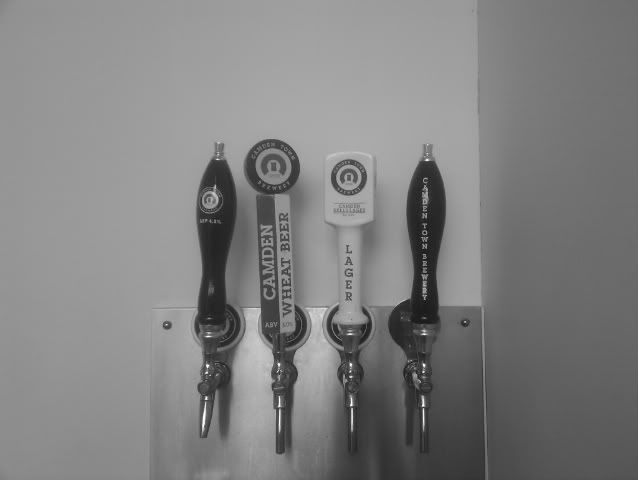
This brewery is a different kettle of fish. London Fields is brand new, still experimenting and just getting to grips with their brews. In comparison Camden Town, situated underneath Kentish Town overground station is a serious operation. They are concentrating on three main beers, honing them to perfection and using the best technology available. Let's not forget, these guys opened for business only last year and are still very small compared to some of the better known craft brewers. They have flavour at the front of their minds and only minor usage of (vegan friendly) filtering - and zero pasteurisation - ensures they keep it that way. I'm going to talk about just two of their beers which we hope to stock; Camden Hells Lager and Camden Wheat Beer.


The Lager is mega-clean and very refreshing which is exactly what you want from a lager. This beer is not about big flavours, but what's there is very well balanced. Delicate toasty notes and subtle bitterness mingle with some light fruit flavours. But the real point of this beer is to be refreshing and it's a perfect thirst quencher.

The Wheat Beer is a little different. This is a flavour bomb. In the German hefeweizen style it displays all of the banana and bubblegum notes you would hope for, from the aroma to the palate. Mix in some subtle cirtus and bready flavours and a lovely round body and you have a really great quality wheat beer giving the Germans a serious run for their money.

After being forced to stay for another round and sampling their zippy Pale Ale straight from the tank (it's a hard life), it was time to move on to our next port of call. If you're ever in the Camden/Kings Cross area, you need to wander up the Euston Road and pop in the Euston Tap, just outside Euston station. My favourite craft beer bar and on this particular day, showcasing 8 Thornbridge beers on keg and cask. A massive bonus and the most excellent way to finish off one of the best days of beer exploration I have had.


Derbyshire brewery Thornbridge have become a benchmark in the British craft beer scene after only 6 years and it was a real treat to try their beers alongside each other. My two favourites had to be the Sequoia American style pale ale, and Raven, their take on a Black IPA. Sequoia was the real star of the show, mouthwateringly refreshing and dry hopped showing tons of aromatic pine and tropical flavours with a body like a feather duvet. The black IPA was a nice surprise. Often black IPAs are a little too toasty for me (I know it's kind of the point) but I find it clashes with the big hop flavours. Not this one, however - far more chocolate and coffee notes, which alongside the up-front hop bitterness was more like fresh cocoa than burnt toast.

So, blog number one and a day to remember. I will be updating regularly about my explorations of beer, wine and food so keep checking back. In the meantime, you can follow me on Twitter: twitter.com/jimmyhatherley